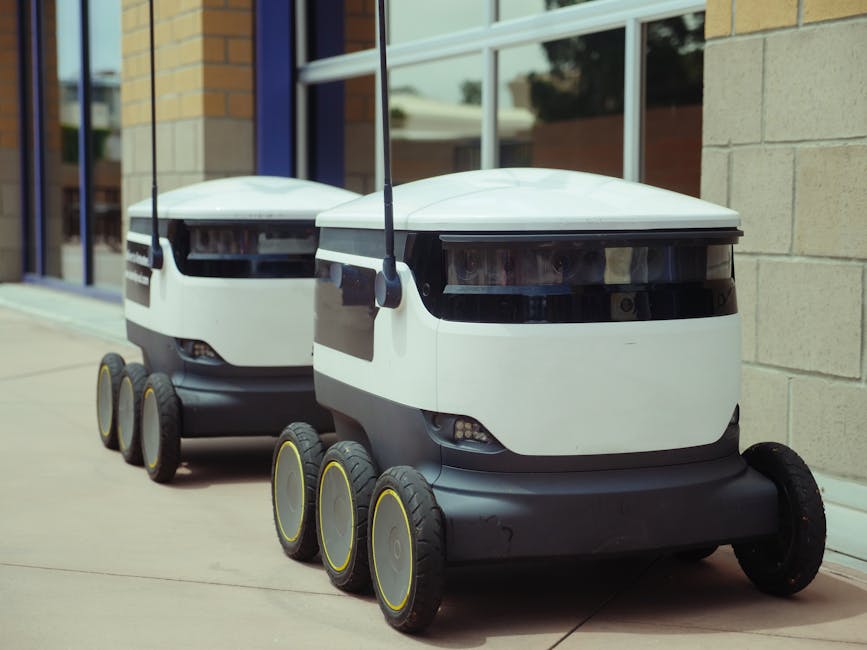
A knee-high robot trundles up to a parked EV on a Dublin side street, plugs itself in, and waddles off to the next car. Science fiction? It's already happening in Germany and the Netherlands. Ireland's turn is closer than you think.
Volkswagen's autonomous charging robot has been in testing since 2021. Startups like EV Safe Charge and Charge Robotics are pushing similar kit across Europe. The pitch is simple: no fixed infrastructure needed, the robot finds the car, does the job, and leaves. For a country where the slow rollout of charge points is already a safety and access issue, that flexibility sounds like a gift. And it might be. Eventually. But drop one of these things onto a typical Irish street today and you have a problem.
The problem is not the robot. The problem is everything around it.
What These Robots Actually Do on a Street
Autonomous charging robots are, at their most basic, self-navigating units that locate a parked EV, establish a charging connection, and return to a docking station. Some carry a mobile battery pack. Others trail a cable from a fixed source. The smarter ones use LIDAR, cameras, and object recognition to move through pedestrian and vehicle traffic. They are, in effect, very slow, very purposeful little vehicles operating in shared public space.
That last part is where Ireland's infrastructure starts to sweat.
A robot navigating a footpath in Rotterdam is dealing with wide, well-maintained, largely flat surfaces with clear kerb definitions and predictable pedestrian flow. A robot navigating Stoneybatter or a housing estate in Tullamore is dealing with cracked paving, cars parked half on kerbs, bins left out mid-week, and the occasional terrier who has opinions. The hardware may be ready. The environment is not.
The Road Infrastructure Gap
Ireland's urban footpaths were not designed with anything autonomous in mind. The RSA's own figures show that pedestrian infrastructure quality varies enormously between urban centres and suburban or rural areas. Dropped kerbs, tactile paving, and consistent surface quality are still patchy outside of city centres.
A charging robot that cannot reliably distinguish a dropped kerb from a pothole, or a toddler from a bollard, is a liability waiting to happen. The navigation algorithms depend on the physical world behaving in predictable ways. Irish streets, with respect, do not always do that.
There is also the question of road markings and parking zones. Robots need to know where a car is legally parked and accessible. Inconsistent bay markings, informal parking cultures, and the sheer variety of street layouts across Irish towns make that harder than it sounds. Before autonomous charging units operate at scale, local authorities need agreed standards for EV parking bays, clear physical demarcation, and surface maintenance that actually happens on schedule. That is not a technology problem. That is a planning and funding problem.
Driver Education: The Bigger Gap
Here is the thing about a new type of road user. Everyone needs to know what it is and how to behave around it. We are not there yet.
Most Irish drivers have never seen an autonomous charging robot. Many have never thought about what the correct response is when one crosses your path. Do you stop? Does it stop? Who has right of way? The Highway Code equivalent for autonomous road robots does not exist in Ireland in any practical, communicated form.
Driver education in Ireland is already stretching to keep up with the pace of vehicle technology. The Essential Driver Training syllabus covers the fundamentals, and well. But it was not built for a world where the thing in front of you on the pavement has a LIDAR array and is trying to reach a Hyundai Ioniq 5 three cars ahead. That gap needs closing before these robots become common sights, not after the first incident.
This is not alarmism. It is sequencing. New road users, whether electric scooters, cargo bikes, or charging robots, require updated public awareness campaigns, updated driving test material, and clear legal status before they integrate safely.
What Regulation Needs to Do First
Right now, autonomous charging robots exist in a legal grey zone on Irish streets. They are not vehicles in the Road Traffic Act sense. They are not quite pedestrians either. The Department of Transport has been doing work on autonomous vehicle frameworks, but ground-level autonomous units operating in pedestrian space are a different and more immediate challenge.
The UK has already begun carving out specific classifications for pavement robots, with trials under controlled conditions and weight and speed limits built into the regulations. Ireland needs to move on a similar track, and quickly. Not because the robots are coming next Tuesday, but because the regulatory frameworks take time to pass and the commercial pressure from operators will not wait around.
Liability is the sharp edge here. If a charging robot causes injury or damage, who pays? The operator? The manufacturer? The local authority who approved the pavement route? Getting that question answered in law, before deployment, is essential. Waiting until after an incident is not a strategy.
What the EV Rollout Teaches Us
Ireland's broader EV charging experience is instructive. The infrastructure arrived faster than the education, the regulation, and the physical environment needed to support it properly. Public chargers were installed in locations that created their own traffic hazards. Drivers unfamiliar with charging etiquette blocked bays. Standards were inconsistent.
Autonomous robots are the next layer of that same challenge. The technology will work. The surrounding systems need to be ready to receive it. That means road surfaces, parking standards, legal frameworks, driver awareness, and public communication all moving in parallel, not scrambling to catch up.
If we get the sequencing right, a charging robot navigating a Dublin street becomes as unremarkable as a delivery bike. If we rush it, we get the same mess we made with scooters, just with a machine that is trying to plug into your car.
The robot is ready for Ireland. The question is whether Ireland is ready for the robot.