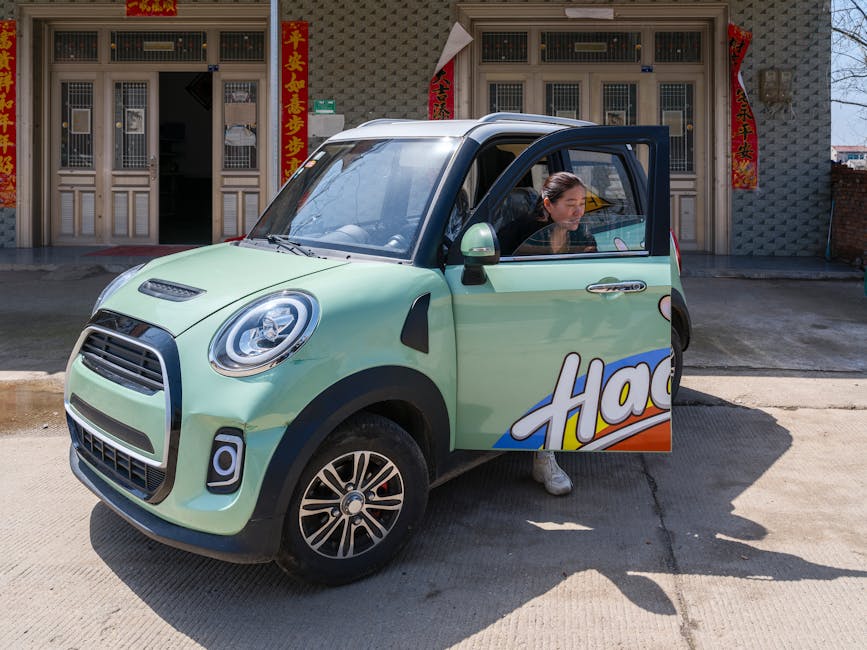
You showed up to buy your first car expecting a battered 2012 Volkswagen Polo for €4,500. The market had other ideas.
The entry-level used petrol car hasn't disappeared, but it's getting squeezed from every direction. Emission-based car tax hits older engines hard. Insurance for young drivers on anything with a decent-sized engine is eye-watering. And the second-hand EV market, which nobody was talking about three years ago, is quietly filling the gap with cars that are cheaper to run than anything burning fuel. If you're getting your licence in 2025 or 2026, your first car might be electric. Not because you campaigned for it. Just because the numbers worked out that way.
This isn't a green manifesto. It's a practical look at what the EV shift actually means for new drivers in Ireland, where the benefits are real, where the catches are, and whether you should lean into it or hold out for something with a gear stick and a petrol cap.
The Price Gap Is Closing (Sort Of)
Used EVs have dropped significantly in value over the past two years. A 2019 Nissan Leaf with around 60,000km on it can now be found for €12,000 to €15,000 from a dealer, sometimes less privately. A 2020 Renault Zoe sits in similar territory. Neither will win any drag races, but both are perfectly capable of getting a new driver through daily life in an Irish town or city.
Compare that to the petrol alternatives at the same price. You're looking at higher-mileage cars, older platforms, and engines that have spent years being driven hard by someone else. The EV has fewer moving parts, which means less to go wrong in the mechanical sense. That matters when you're not yet fluent in car ownership.
The catch is the battery. An older EV with degraded capacity might advertise 150km of range but deliver 110km in winter, in the rain, with the heater running. That's not a disaster if you're commuting 30km a day in Cork or Galway. It is a problem if you're doing regular long runs. Check the battery health report before you buy anything. A used car checklist will only get you so far here. Ask specifically.
Range Anxiety: Real Problem or Urban Legend?
Depends entirely on your life. For most new drivers, range anxiety is mostly theatre.
The RSA's own data consistently shows the average Irish car journey is well under 50km. A Nissan Leaf with even moderate battery degradation handles that without drama. You plug in at home overnight, you start each day full. It's closer to charging a phone than visiting a filling station, once the habit is established.
The anxiety becomes real in two scenarios. First, if you live rurally and the nearest public charger is 40km away and sometimes out of order. Ireland's public charging network has improved but it's patchy, and the slow rollout of reliable charge points is a genuine issue outside the main urban corridors. Second, if your accommodation doesn't allow home charging. Apartment dwellers without a dedicated parking spot are genuinely stuck. No driveway means dependence on public infrastructure, and that infrastructure isn't yet seamless.
If you own a house with a driveway, or you're parking on a private property where a charger can be fitted, the anxiety mostly dissolves after the first week.
What Does Charging Actually Cost?
Home charging on a standard overnight rate runs at roughly €0.15 to €0.22 per kWh depending on your tariff. Filling a 40kWh Nissan Leaf from near-empty costs about €6 to €9. That gets you 200km in good conditions, maybe 140km on a bad day. Public fast chargers are more expensive, often €0.50 to €0.60 per kWh, but you're not using those daily.
Petrol at current Irish prices is running above €1.70 per litre in most counties. A small petrol hatchback doing 6 litres per 100km costs roughly €10 per 100km to run. The Leaf costs €3 to €4.50 per 100km on home charging. Over a year of regular driving, that gap is meaningful money for someone who's also absorbing the shock of first-time insurance premiums.
Speaking of which, EV insurance for young drivers isn't automatically cheaper. Some insurers are still treating EVs as a specialist category. It's worth shopping specifically rather than assuming the lower running costs extend to your premium.
Do Your Driving Lessons Change?
Your EDT lessons don't change because your car is electric. The 12 lesson structure covers observation, junctions, roundabouts, night driving, motorways. None of that is powertrain-specific.
What does change slightly is the physical experience. EVs have instant torque. You press the accelerator and the car responds immediately, with no lag waiting for revs to build. For a learner used to the gentle stall-or-not dance of a petrol manual, this takes about ten minutes to get used to. Most new drivers find it easier, not harder.
The bigger question is whether you're learning in a manual or automatic. An EV is always automatic. If your lessons and test are done in an automatic, your licence will carry the automatic restriction until you pass a manual test. That's worth knowing before you commit. If you're already leaning towards automatics, an EV simplifies the whole thing.
So Should Your First Car Be Electric?
If you live in a city or large town, have somewhere to charge at home, and your daily driving is under 80km, an entry-level used EV makes a compelling first car right now. Lower fuel costs, lower tax, fewer mechanical failures in the first years of ownership. The numbers are on its side.
If you're rural, charge-point dependent, or regularly driving long distances, the petrol option still has a practical case. A 2018 Toyota Yaris with 80,000km is predictable, easy to service anywhere in the country, and won't leave you calculating range margins on a wet Tuesday in Roscommon.
The market you were expecting, a cheap petrol runabout with low tax and manageable insurance, still exists. It's just smaller than it was, and it's getting smaller every year.
You showed up expecting a Polo. You might drive away in a Leaf. It'll probably suit you fine.