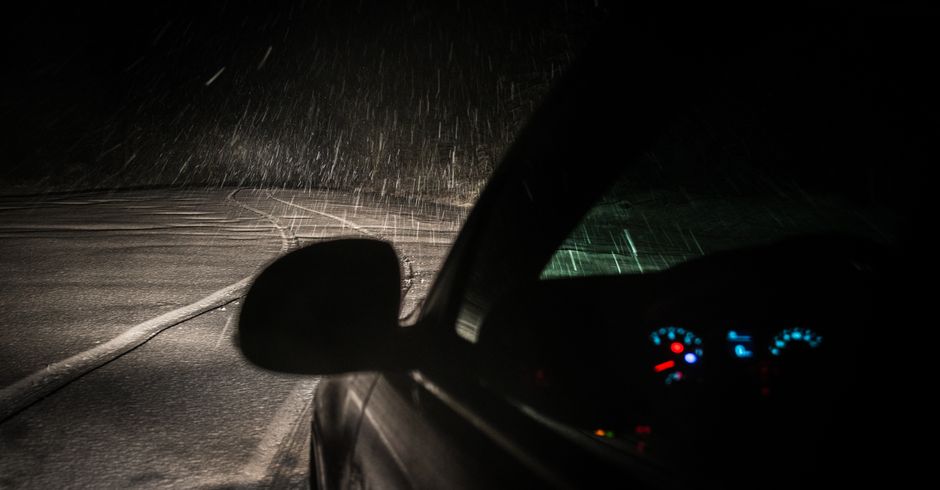
You hear nothing. That's the point. And on a badly lit road outside Athlone at half nine on a November evening, "you hear nothing" is exactly the problem.
Electric vehicles are selling fast in Ireland. The RSA's own figures show EVs now account for a growing slice of new registrations year on year, with tens of thousands of fully electric cars now on Irish roads. Grand for the environment. Genuinely impressive engineering. But there's a visibility gap between what these cars were designed for and where many of them end up driving, and it's one the industry and road planners have been slow to close.
The Silence Problem Is Real, Not Theoretical
Internal combustion engines give off constant acoustic information. You hear a car approaching a junction. You hear one edging out of a carpark. You hear it before you see it, especially at night, especially on roads where the lighting budget clearly ran out somewhere around 2003.
EVs under 20km/h are required by EU law to emit an Acoustic Vehicle Alerting System (AVAS) tone. Above that, tyre and wind noise is supposed to do the job. In theory, fine. In practice, on a rural road with a wet surface, hedgerows on both sides, and zero ambient light, that theoretical noise profile is close to useless for a pedestrian or cyclist who is already competing with rain and wind.
The AVAS requirement was a step. It was not a solution.
What Irish Roads Actually Look Like After Dark
Ireland is not Amsterdam. It is not even Birmingham. The rural road network is vast, poorly funded, and in many stretches, completely unlit. Local and regional roads account for the bulk of Ireland's road network by length, and enormous sections carry no street lighting at all.
That's not inherently a problem for a loud car with a full-beam headlight that announces itself well in advance. It becomes a bigger issue when the car is whisper-quiet, when the driver might be relying on automatic high-beam assist that dips too early, and when a cyclist or pedestrian has stepped onto the road assuming they would hear something coming.
Road safety researchers have flagged this consistently. The specific concern is not that EVs have bad headlights. Most modern EVs have excellent lighting systems. The concern is the acoustic early-warning that other road users historically relied on, even unconsciously, is simply gone. Night driving and EV range anxiety are usually discussed together in terms of battery performance. The pedestrian standing in the dark barely gets a mention.
Car Parks: The Underrated Danger Zone
Rural roads get the headlines but car parks are where the AVAS gap bites hardest. Multi-storey car parks, supermarket car parks at closing time, hospital car parks at all hours. Enclosed, echoing spaces where people are distracted, often tired, and used to hearing engines.
A 2021 study published in the journal Accident Analysis and Prevention found that EV and hybrid vehicles were involved in pedestrian incidents at significantly higher rates in low-speed environments than equivalent petrol cars. The difference was most pronounced in parking areas and urban streets below 30km/h. Precisely the zones where AVAS operates, yes, but also precisely where the AVAS tone can be masked by ambient noise, trolley wheels, car park ventilation systems, or someone's earphones.
The issue is not that EV manufacturers are careless. It is that the whole system, AVAS tones, road lighting standards, pedestrian behaviour expectations, was designed for a world where nearly every moving car made substantial noise. That world is changing faster than the infrastructure assumptions underneath it.
What Needs to Change
Better AVAS standards. The current EU minimum is a starting point, not a finishing line. Some manufacturers already exceed it. Volvo and BMW have invested in more directional and speed-sensitive tones. The minimum should become the floor, not the ceiling.
Rural road lighting investment. This one is straightforward and expensive, which is why it keeps getting deferred. Ireland's rural local road network needs targeted lighting at known pedestrian crossing points, junctions, and village approaches. A programme prioritising accident blackspots and school routes would save lives. It would also cost money nobody wants to allocate.
Updated driver education. Learning to drive in 2026 is increasingly learning to drive an EV or hybrid. Learners should be explicitly taught that other road users may not hear them approaching, and that the duty of acoustic awareness has, in effect, shifted more squarely onto the driver. Check junctions with extra care. Use the horn at blind bends. Don't assume pedestrians know you're there.
Car park design standards. New commercial developments should face requirements around pedestrian crossing lighting, speed ramp placement, and clear pedestrian routes that account for the quieter vehicle mix now entering those spaces. Planning conditions exist for exactly this kind of thing. Use them.
Aftermarket visibility options. Some EV owners have taken matters into their own hands with under-car ambient lighting, brighter running light modifications, and reflective detailing. Reasonable in principle. The legal framework around aftermarket lighting modifications in Ireland is patchy, and clearer guidance from the RSA would help people who want to do the right thing actually do it correctly.
The Bigger Picture Nobody's Drawing
Ireland's roads are getting incrementally safer on headline metrics. Fatality numbers have broadly trended down over decades. But the vehicle mix is changing faster than the supporting infrastructure, the lighting networks, the road design, the education frameworks. That gap creates specific new risks even as old ones fade.
The quiet revolution in motoring is genuinely positive. Zero-emission driving, lower running costs, smoother journeys. But "quiet revolution" should not be taken literally on a dark road in Roscommon at ten o'clock on a wet Wednesday.
The car you couldn't hear coming was always the dangerous one. We just used to only worry about that after the fact.