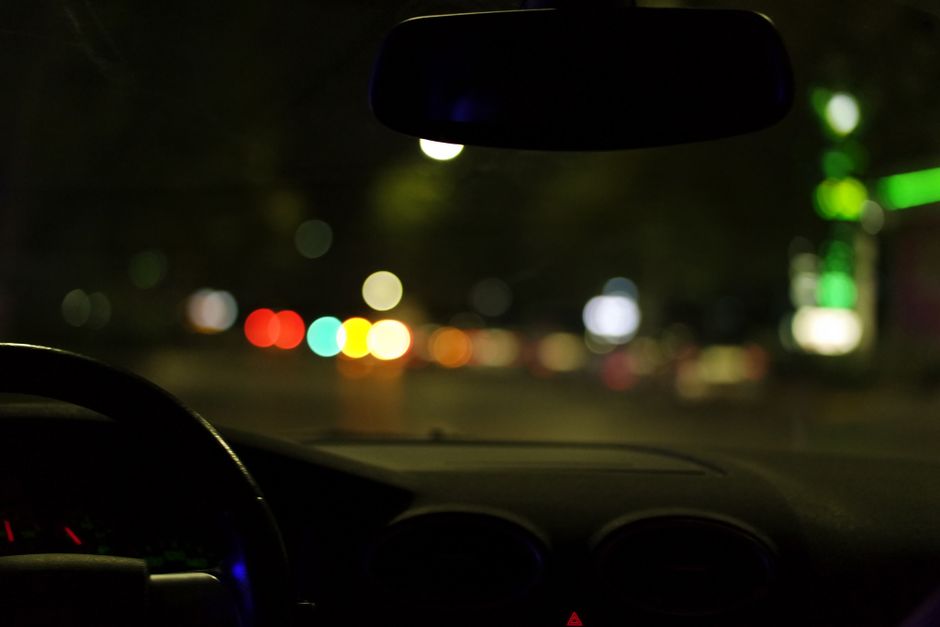
You squint at an oncoming headlight and it blooms into a starburst. The road signs blur at the edges. You tell yourself it's just the rain on the windscreen. It isn't.
Driving at night with astigmatism or cataracts is one of those slow-burn problems Irish drivers ignore until it becomes genuinely dangerous. Neither condition arrives with fanfare. They creep in. And because daytime driving often feels fine, people assume they're grand. They're not always grand.
What Astigmatism Actually Does at Night
Astigmatism means the cornea or lens of your eye isn't perfectly round. Instead of focusing light neatly onto your retina, it scatters it. In daylight, your pupils are small and this mostly doesn't matter. At night, your pupils dilate to let in more light, and suddenly that scatter is in charge. Oncoming headlights turn into starbursts or streaks. Lane markings lose their crispness. Wet roads become a mosaic of distorted reflections.
This is why driving at night with astigmatism feels so much worse than driving in daylight. It's not in your head. The optics are working against you once the sun goes down.
The fix is usually straightforward: corrective lenses, specifically prescribed for the astigmatism. Anti-reflective coatings on glasses help significantly with glare. The problem is that many people are driving on an outdated prescription, or don't even know they have astigmatism at all.
What Cataracts Do Behind the Wheel
Cataracts cloud the lens of the eye. Early on, you might not notice much. As they develop, the cloudiness scatters incoming light, which creates glare, halos around lights, and a general washed-out quality to your vision, especially in low light. Night driving becomes the first casualty.
Cataracts are strongly associated with age, but they're not exclusively an older person's problem. UV exposure, certain medications, and diabetes can accelerate them. The RSA's own research consistently flags older drivers as a group where undiagnosed vision problems are most likely to be a factor in collisions.
The good news: cataracts are treatable. Surgery is routine, effective, and available through the public system (with waiting times) or privately. Many people describe the difference after surgery as like cleaning a fogged-up windscreen you'd stopped noticing was dirty.
The NDLS Eyesight Standard: What You Must Meet
The National Driver Licence Service sets out minimum vision requirements for holding a driving licence in Ireland. For standard car licences (category B), you need:
Visual acuity: At least 0.5 (6/12 on the Snellen scale) in both eyes together, with or without corrective lenses.
Visual field: A minimum horizontal field of 120 degrees, with no significant defect in the central 20 degrees.
Double vision: Any uncorrected double vision is a bar to driving.
If you need glasses or contacts to meet the standard, your licence will carry a restriction code (01) requiring you to wear them while driving. Driving without them when that code is on your licence is an offence.
Cataracts can eat into your visual acuity and visual field. Advanced astigmatism can affect acuity. Neither condition automatically means you fail the standard, but both can get to a point where they do. The issue is that the NDLS standard is a floor, not a ceiling. Meeting it doesn't mean your vision is good for night driving. It means it meets the legal minimum.
When to See an Optician
The honest answer is: sooner than you think you need to. Most opticians recommend a check every two years for adults under 60, and annually after that. But if you're noticing any of the following while driving at night, don't wait for the next scheduled appointment:
- Halos or starbursts around lights
- Difficulty reading road signs at distance before you're close to them
- Increased sensitivity to oncoming headlights
- Needing to slow down more than you used to on unlit roads
- Misjudging the distance of oncoming vehicles
These are not symptoms of tiredness or age. They're symptoms of a vision problem that may be treatable, and that is making you less safe on the road. Our full guide to safer driving at night covers the broader picture of managing night-driving conditions, but vision is the foundation everything else rests on.
Practical Steps If You Already Know You Have Either Condition
Get your prescription checked. If it's more than two years old, it's probably not accurate. Vision changes gradually, and an outdated prescription can be almost as bad as no prescription at all for night driving.
Ask about anti-reflective coatings. If you wear glasses, this is the single biggest practical upgrade for night driving with astigmatism. It cuts the scatter from oncoming headlights significantly.
Keep your windscreen genuinely clean. A film of grime on the inside of a windscreen amplifies glare badly, especially for eyes already dealing with astigmatism or early cataracts. Use a proper glass cleaner, not a dry cloth.
Don't lean on high beams as a crutch. Switching to full beam helps you see further, but it doesn't fix the core problem and it creates the same starburst effect in oncoming drivers who may also have compromised vision. Use them on empty rural roads. Drop them when there's traffic.
Talk to your GP about cataracts. If your optician flags them, ask for a referral. Early-stage cataracts don't necessarily need surgery yet, but knowing where you stand means you can make informed decisions about how much night driving you should be doing in the meantime.
Consider a glare-reducing lens tint. Some opticians offer specific night-driving lenses. The evidence is mixed on how much these help versus a good anti-reflective coating, but it's worth raising with your optician if glare is your main complaint.
The Bit Nobody Wants to Hear
If your optician or GP tells you that your vision has deteriorated to a point where night driving is genuinely unsafe, the right move is to stop doing it until it's addressed. That might mean waiting for cataract surgery. It might mean getting a prescription sorted. It's annoying. It's also not negotiable.
Irish roads at night, particularly unlit rural roads, are unforgiving. The RSA's figures on night-time collision rates make grim reading. Adding compromised vision to that environment is a risk you're not just taking for yourself.
The starburst in your wing mirror is worth getting checked. It was worth checking last year too.