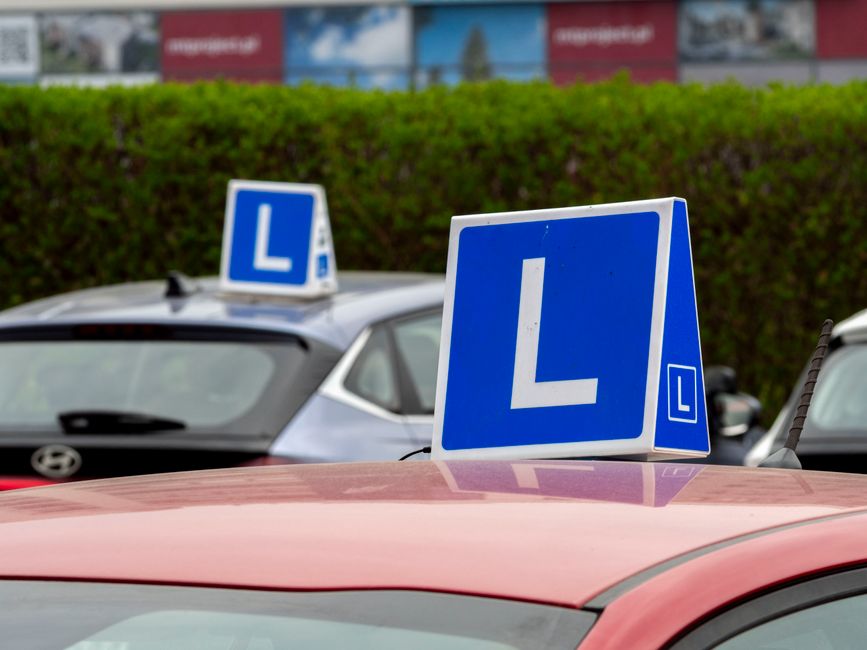
Your driving instructor spent forty minutes last Tuesday explaining clutch control on a 2019 Volkswagen Polo. That same evening, a Hyundai Ioniq 6 pulled silently out of the test centre car park and nearly gave a pedestrian a heart attack.
Both of those things happened. Only one of them is part of the official curriculum.
The Curriculum Is Living in 2014
Ireland's Essential Driver Training programme, the famous 12 EDT lessons that every learner has to complete, was designed around a world where petrol was king and the only decision you made at a fuel stop was whether to bother cleaning the windscreen. That world still exists. But it's shrinking fast.
The RSA's own figures show EV registrations in Ireland have climbed steadily year on year. New electric cars launching in Ireland in 2026 now span every price bracket. A learner who passes their test this year and then goes to buy their first car in two or three years is looking at a market where electric options are no longer niche. They might be the default.
So we're training people for a petrol world and then sending them into something else entirely. Grand system.
What's Actually Different About Driving an EV
Here's the thing. The basics don't change. You still need to observe, signal, manoeuvre. You still need to not drive into a ditch on the N52. But the texture of the experience is different in ways that actually matter for new drivers.
Instant torque is not a metaphor. Press the accelerator on an EV and the power is there immediately, with no lag, no gear change, no build-up. For a learner who's been conditioned to the gentle roll of a diesel Fiesta, that can be startling. We're not talking about a Porsche Taycan here. A Nissan Leaf or a Renault Zoe will still catch you out if you press the pedal like you mean it at a junction.
Regenerative braking changes everything about your following distance. When you lift off the accelerator in an EV, the car slows. Sometimes quite firmly. Learners need to understand this before they're in traffic, not after they've collected someone's bumper.
The silence is a genuine hazard. Pedestrians, cyclists, kids playing near a driveway. An EV at low speed is essentially silent. Experienced drivers adjust. Learners, already managing six things at once, may not think to compensate for the fact that their presence is no longer announced by engine noise.
Range and charging aren't just admin. Understanding how to read a state of charge, how real-world range differs from advertised range, how to plan a longer journey around charge points: these are practical skills. Sticking a learner in a car they've never managed the energy of and hoping it goes fine is not a training philosophy, it's optimism.
What Should Actually Change in Driver Training
Instructors Need the Knowledge First
You can't teach what you don't know. Many excellent driving instructors in Ireland have spent their careers in internal combustion vehicles. That's not a criticism. It's just physics. If the curriculum is going to expand to cover EV-specific skills, instructors need structured training on what's different and why it matters. The ADI qualification process exists for exactly this kind of update. Use it.
Introduce EV Awareness as a Standalone Topic
Right now, an ambitious instructor might mention regenerative braking in passing. Most don't, because it's not on the test. Make it formal. A short, dedicated section within the EDT structure covering: torque characteristics, regen braking behaviour, charging basics, and low-speed acoustic awareness. Not a full extra lesson necessarily. An integrated component that gets covered, assessed, and taken seriously.
The Theory Test Needs to Catch Up Too
The theory test still leans heavily on petrol and diesel knowledge. Fuel grades, engine management lights, oil levels. All still relevant, not going anywhere. But there's no meaningful coverage of EV-specific knowledge. What does a battery charge indicator mean? When is it safe to charge in rain? What does a charging fault warning look like? These questions don't currently appear. They should.
Practical Experience in an EV Should Be Available
This is the hard one, because most driving schools still operate a fleet of manual petrol cars. Cost is real. Transition takes time. But schools that can offer even one or two EV lessons as part of the overall programme are giving their learners something genuinely useful. A 2024 BYD Dolphin or a used Nissan Leaf doesn't need to replace the entire teaching fleet. It just needs to exist in it.
The Automatic Question
There's a layer to this that doesn't get discussed enough. EVs are automatic. All of them. And Ireland's learner system still defaults heavily to manual transmission, partly by habit, partly because passing in a manual gives you an unrestricted licence. Passing in an automatic limits you to automatics.
That rule made sense when automatics were a premium feature on expensive cars. It makes considerably less sense when the majority of new EVs don't have a clutch pedal. Learning to drive in an automatic car is already a conversation worth having. As EV uptake accelerates, it becomes a more pressing one.
Who Carries the Can
The RSA sets the curriculum. Driving schools implement it. Learners receive it. If any part of that chain is slow to adapt, the learner is the one who arrives at an unfamiliar car without the tools to drive it safely.
That's not a theoretical problem. It's already starting to happen. A learner who passes their test, joins their parent's household where the family just bought an EV, and then drives it for the first time with no specific training in how that car behaves is a gap in the system, not a one-off scenario.
The roads aren't waiting for the curriculum to catch up. The cars are already there.