Gardaí handed out fines on the M50 and several national routes this week before 9am. Fog. The kind that makes the car ahead of you disappear at 80 metres. And yet, a significant number of drivers caught without headlights on genuinely believed they were doing nothing wrong.
That's not arrogance. That's a gap in driving knowledge that the system never bothered to close.
Met Éireann issued a Status Yellow fog warning covering much of Leinster and parts of Munster. Visibility dropped below 100 metres on stretches of the M1 and N7 during the morning commute. Gardaí ran enforcement checkpoints. Fines of €80 to €120 landed on drivers who had no rear fog lights, no headlights, or who were using hazard lights incorrectly. Most of them, by all accounts, thought they were fine.
What the Law Actually Says
The Road Traffic (Lighting of Vehicles) Regulations are not written to be read by humans. But strip the official language away and the rule is this: you must use headlights when visibility falls below 100 metres.
Not 90 metres. Not "when you feel like it." One hundred metres is roughly the length of a football pitch. If you cannot clearly see that far ahead, your lights should be on. Full stop.
Rear fog lights kick in at the same threshold. Front fog lights, where fitted, follow the same rule. The mistake most drivers make is waiting until they can barely see the bonnet before they reach for the stalk. By then you've been driving blind, relative to the law, for some time.
The Hazard Light Problem
Here's where it gets worse. A large number of the fines issued this week were for improper use of hazard lights. Drivers thought they were being cautious. They were actually making things more dangerous.
Hazard lights are for stationary or broken-down vehicles. Full stop. Using them while moving in fog tells drivers behind you nothing useful. They cannot read your brake lights when your hazards are on. They cannot tell if you are slowing, stopping, or turning. The RSA has been consistent on this point for years, and yet the behaviour persists because nobody explained it clearly the first time round.
If you're moving, your hazards should not be flashing. That's the rule. Dipped headlights and rear fog lights do the job they're supposed to do.
The 100-Metre Test
So how do you judge 100 metres from behind the wheel? A few useful reference points.
A standard Gaelic pitch is around 140 metres long. If you're on a rural road and you cannot see to where the hedges start disappearing into grey, you're likely already under 100 metres. On a motorway, the green overhead gantries are typically spaced at 500 to 1000 metre intervals. If you cannot see the next one clearly, it's lights on.
Bridge parapet to bridge parapet on a typical Irish road is often 80 to 120 metres. Know the roads you drive regularly. That knowledge is free and it might save you a fine.
What You Should Have On, and When
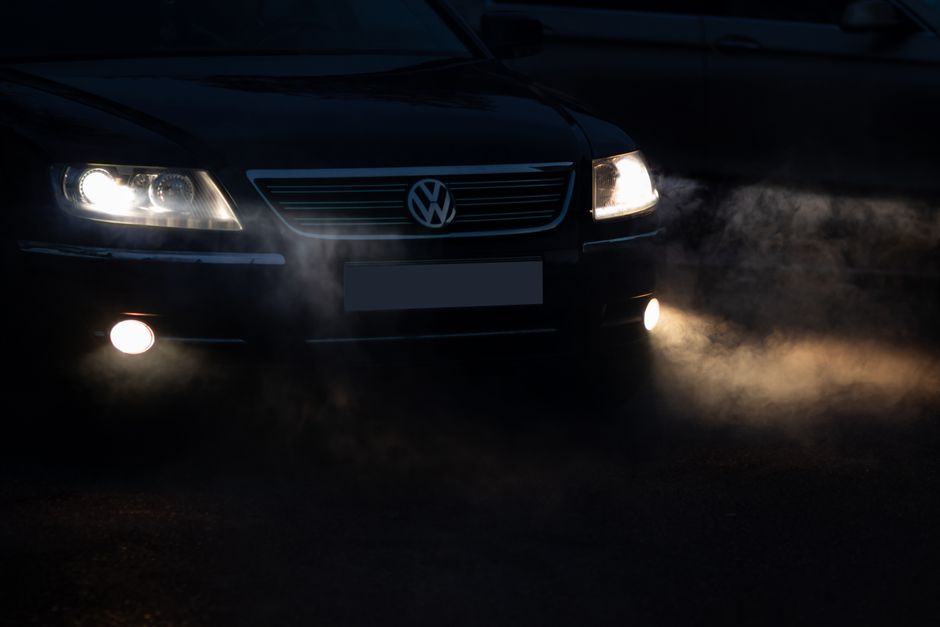
Dipped headlights: on whenever visibility drops below 100 metres. Also on in heavy rain, in dusk conditions, and when driving at night. They're not just so you can see. They're so other road users can see you. Full beam in fog is worse than nothing. It bounces off the fog and reduces your own visibility.
Rear fog lights: on when visibility is below 100 metres. Turn them off when conditions improve. Rear fogs are bright enough to blind the driver behind you on a clear road, and leaving them on when the fog lifts is both inconsiderate and potentially dangerous.
Front fog lights: on when visibility is below 100 metres, if your car has them. Not for general use, not because they look well, not because it's a bit drizzly on the N4.
Hazard lights: not while moving. This is not a suggestion.
Why This Fine Catches So Many Drivers Off Guard
The driving test asks about lights. The theory test covers fog rules. But passing both tests is a full route from learner permit to full licence that most people complete and then largely forget about. The visibility rules are filed somewhere between "parallel parking" and "which way does a yield sign point." Useful once. Then gone.
There's also a cultural habit of copying the car ahead. If the car in front has no lights on, most Irish drivers assume it's fine to do the same. It is not. You are each responsible for your own vehicle's compliance. The fact that your man in the Avensis is also getting a fine is not a defence.
The Fine Itself
An on-the-spot fine for a lighting offence in the Republic sits at €80 currently, with penalty points possible if prosecuted to court. In Northern Ireland, where some of this week's warnings also applied, the figure is around £100 with up to three points on your licence.
For a rule that takes thirty seconds to explain and costs nothing to follow, the maths is fairly clear.
What to Actually Do Next Time a Warning Goes Out
When Met Éireann issues a fog warning, treat it like a signal to check three things before you leave: headlights on (dipped), rear fog light on, hazards off. That's the entire checklist. It fits on the back of a receipt.
The five safety blind spots that catch Irish drivers out every winter include this one, every year, without fail. Fog is not an edge case in Ireland. It is a seasonal reality on every stretch of road from Monaghan to Macroom.
You were warned. Literally. Met Éireann sent the warning. Gardaí were out. And still, hundreds of drivers rolled through the fog with sidelights, hazards flashing, or nothing at all.
Next time the warning goes out, you know the number. One hundred metres. Everything else follows from that.