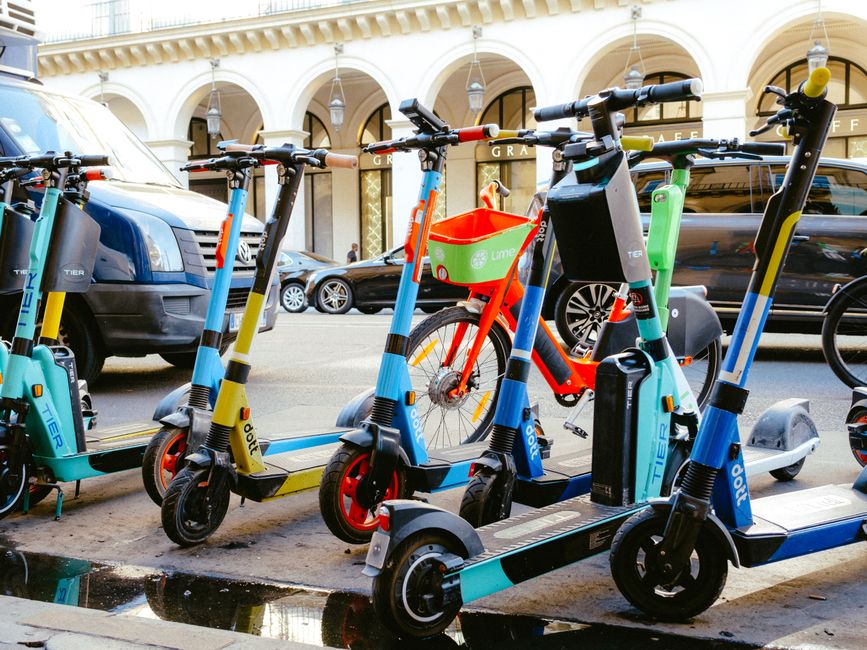
For years, your man on the e-scooter was technically breaking the law every time he rolled past you at the lights. Now he isn't. But that doesn't mean anything goes.
Ireland finally brought e-scooters and e-bikes into the legal fold under the Road Traffic and Roads Act 2023, with the specific regulations kicking in from July 2024. It was a long time coming. Thousands of people were already using both daily, navigating a legal grey zone that left guards scratching their heads and riders genuinely unsure where they stood. The legislation cleared that up. Mostly.
What it also did was create a new layer of road-sharing that every driver in the country needs to understand. Because if you're behind the wheel and you don't know the rules for these things, you're the one who's going to come off worst in an argument with an insurance assessor.
What Counts as an E-Scooter Under Irish Law
Not every electric scooter qualifies as a legal "powered personal transporter" under the new rules. The law is specific.
To be legal, a scooter must have a maximum speed of 25km/h, a motor no bigger than 400 watts, and weigh no more than 25kg. It has to have working brakes, front and rear lights, and a bell or horn. If it exceeds any of those limits, it isn't a powered personal transporter. It's an unregistered motor vehicle, and riding it on public roads is a different kind of trouble entirely.
Riders must be at least 16 years old. No licence is required, but that also means no insurance requirement for the rider. That detail matters if you're in a collision with one.
Where E-Scooters Can and Cannot Go
This is where people get it wrong most often.
Legal e-scooters can use cycle lanes, shared paths, and roads with a speed limit of 50km/h or below. They are banned from motorways, national roads, and footpaths. Full stop.
The footpath ban is worth underlining. Plenty of riders still treat the pavement as their personal shortcut. It's illegal, and vulnerable road users in Irish cities are already navigating enough hazards without a 25kg scooter appearing silently behind them.
The RSA's own guidance is clear: if there's no cycle lane and the road limit is above 50km/h, the scooter doesn't belong there.
The Speed Limit Is Real, Not a Suggestion
Twenty-five kilometres per hour is the legal cap. Some scooters, particularly imported models bought online, are capable of going much faster and may have been modified or simply never speed-limited at the factory. Riding one of those on a public road moves you out of the "powered personal transporter" category and into motor vehicle territory, with all the consequences that come with it.
Gardaí can and do stop riders. Fixed charge notices exist for a range of offences, including riding on footpaths, failing to have lights after dark, and exceeding the speed limit. The fines aren't enormous but the points question is live for anyone holding a driving licence.
E-Bikes: A Different Beast Entirely
E-bikes have been legal in Ireland for considerably longer, governed by EU regulations rather than the 2023 act. But there's still widespread confusion about what an e-bike actually is under Irish law.
A legal e-bike, or "electrically assisted pedal cycle" (EAPC), must have a motor that only assists when the rider is pedalling, a motor output capped at 250 watts, and assistance that cuts out above 25km/h. If your bike has a throttle that moves it without pedalling, or the motor keeps pushing past 25km/h, it is not a legal e-bike. It's a moped, and you need tax, insurance, and a licence.
This catches a lot of people out. The throttle-equipped bikes that look like e-bikes but function more like motorbikes are genuinely common, and many riders have no idea they're uninsured on a vehicle that legally needs a licence plate.
Legal e-bikes can go anywhere a regular bicycle can go. No age limit. No licence. No insurance required, though it's worth getting some anyway given how much Irish insurance markets have shifted for all road users recently.
What Drivers Need to Understand
Both e-scooters and e-bikes are quiet. Much quieter than you expect. At junctions, turning out of side roads, pulling out of a parking space, the gap you're checking for cars may contain a rider doing 24km/h who makes almost no sound at all.
The RSA has flagged the detection gap specifically. Human brains are wired to listen for engine noise as a cue that something's coming. E-scooters and e-bikes remove that cue entirely.
Practical points for drivers:
At junctions. Check twice in each direction before pulling out. E-bike riders in particular can cover ground quickly and silently.
When overtaking. Give at least 1 metre of clearance when passing a cyclist or e-scooter rider. That's a legal requirement under Irish road rules, not just good manners.
At bus stops and cycle lanes. Don't drift into the cycle lane at junctions, even briefly. It's where these riders are supposed to be.
Dooring. Opening your car door into a rider is a collision you caused. Check your mirror before opening. Every time.
Age, Helmets, and the Rules Nobody Reads
Helmets are not legally required for e-scooter riders under the current rules, though the RSA strongly recommends them. For anyone under 16, this is moot because under-16s cannot legally ride e-scooters at all.
E-bike riders have no helmet requirement either, same as standard cyclists. Again, the RSA recommends it. The law doesn't enforce it.
What is required: lights front and rear between sunrise and sunset. A bell. Reflectors. And for scooters specifically, the technical specs that bring the device within the legal definition. Ride an oversized, over-powered scooter and you're exposed on multiple fronts at once.
The Bit That Still Needs Sorting
Ireland's legislation is a decent start but it left some gaps that are going to cause arguments.
Insurance for e-scooter riders remains voluntary. If a rider collides with a pedestrian and causes serious injury, there's no mandatory cover in place to compensate the victim. That's a live policy problem, and consumer groups have been making noise about it since the law passed.
Enforcement is also patchy. Gardaí have the powers but the volume of riders, the speed of incidents, and the absence of registration plates make consistent enforcement genuinely difficult.
For now, the rules exist. Whether everyone follows them is another matter. But knowing them, whether you're on two wheels or four, is the least you can do before you share the road.
E-scooters went from technically illegal to technically regulated. The road didn't get any wider.