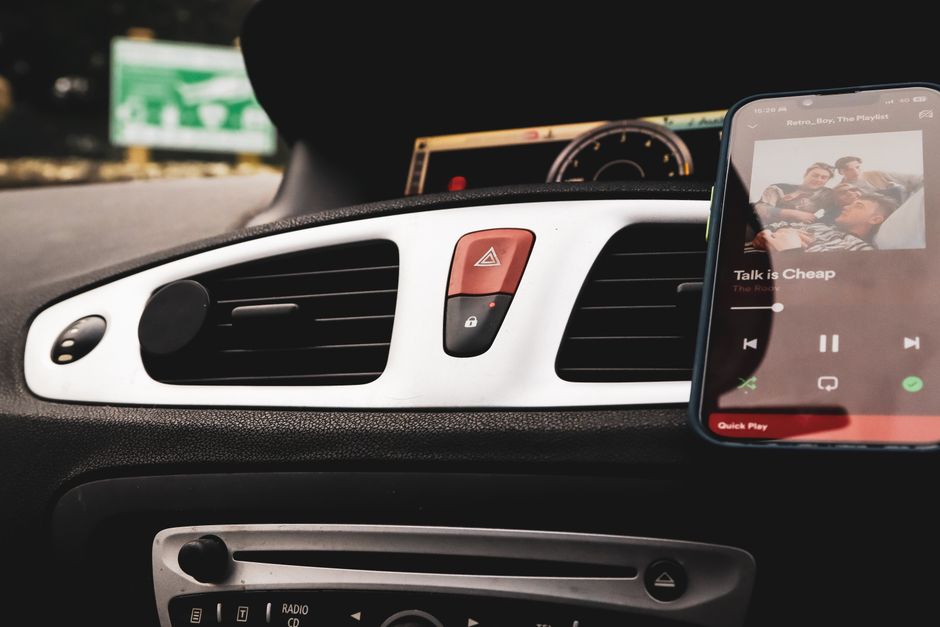
You're on the M6, heading west, rain doing its usual thing. You want to switch albums. With your old setup, that's your phone, your mount, a tap, a swipe, another tap. With Audi's native Spotify integration, it's a scroll of the MMI dial or a voice command that actually works. Small difference. Big consequences.
This isn't a feature launch piece. Audi has been rolling out embedded Spotify across its newer models for a while now, and it's starting to become a real-world talking point among Irish drivers doing serious motorway kilometres. The question isn't whether it sounds impressive in a showroom in Sandyford. The question is whether it makes you safer, or just more comfortably distracted.
What "Native Integration" Actually Means
Phone mirroring, whether through Apple CarPlay or Android Auto, is still screen mirroring. Your phone is doing the work. The car is just the display. Native integration is different. Spotify runs directly on the car's own hardware, authenticated through your account, with no phone involved at all. You could leave your phone in a hotel room in Athlone and still have your full Spotify library on the drive home.
For Irish motorway driving, this matters in a few practical ways. First, you're not burning mobile data from your phone plan at the rate you would streaming through CarPlay. The car uses its own eSIM connection. Second, there's no mirroring lag. When you hit pause on the MMI dial, it pauses immediately. It sounds trivial. It isn't when you're at 120km/h and the half-second delay between intention and result is the thing that makes you glance down.
Third, and this is the one people underestimate: voice commands work properly. When Spotify is native, Audi's voice assistant can control it with context. "Skip," "Play something similar," "Next playlist." These work. When you're doing them through a mirrored phone, the command has to travel from car to phone to app and back. That chain breaks more often than it should.
The Motorway Case for It
Long Irish motorway runs are a specific kind of driving. The M1 from Dublin to Belfast. The M8 down to Cork. The N17 if you're heading into Connacht and the motorway eventually runs out. These are journeys where you're settled into a lane, adaptive cruise is probably on, and your main job for long stretches is staying alert.
Music management on these routes is constant. Not because drivers are fiddling endlessly, but because a two-hour playlist actually ends. Because an ad-supported account suddenly throws up something jarring mid-motorway. Because you want to switch from a podcast to something with a beat. On a motorway, those small interactions are less dangerous than they'd be on a national road with junctions. But they're still interactions, and anything that reduces the number of times your eyes leave the road is worth examining.
The RSA's own road safety data consistently points to distraction as a primary factor in serious collisions. Embedded controls that let you manage audio without touching a phone address at least one layer of that problem.
Where the Safety Argument Gets Complicated
Here's the bit the marketing won't tell you. Native integration doesn't make the interaction disappear. It moves it. Instead of picking up your phone, you're reaching for the MMI rotary dial or the touchscreen. That's still a distraction. It's possibly a more seductive one, because it feels sanctioned. It's built into the car. It must be fine.
It isn't automatically fine. Distracted driving on Irish roads is already a serious concern, and the availability of richer in-car content, better playlists, higher quality streaming, more things to navigate, raises the ceiling on how absorbed a driver can become in their infotainment. The Audi MMI is a well-designed system. It's also one of the most feature-dense systems on the market. Native Spotify adds another layer to an already deep stack.
Voice control is the genuine safety gain here. If you're using it properly, you're keeping both hands on the wheel and both eyes forward. The problem is that voice control is still not fast enough for everyone's patience. When it works, it's great. When it mishears "Fleetwood Mac" for the third time, you're reaching for the screen. And that's the exact scenario where the safety case collapses.
What It Means for Irish Road Trips Specifically
Irish road trips have a particular rhythm. The motorway section is grand. It's when the motorway runs out and you're on an N-road through a market town that things get interesting. That transition is where you want your infotainment sorted before you leave the dual carriageway, not halfway through a 50km/h zone in Ballinasloe.
Native Spotify, used intelligently, is a tool for setting up your audio environment in advance. Pick your playlist before the junction. Let it run. Don't touch it again until you're parked at a petrol station. That's the use case where this feature actually delivers what it promises.
Which Audis Have It and What You Need
Currently, native Spotify integration is available across Audi's newer MMI-equipped models, including the A3, A4, Q3, Q5, Q7, and the e-tron range. You need a connected SIM-enabled vehicle (most post-2020 Audis with Audi Connect qualify), an active Spotify account, and a one-time pairing through the Audi myConnect portal.
It's worth checking your specific model's connectivity tier. Some base-spec cars have the hardware but not the active data plan, meaning you'd still need to tether through your phone's hotspot. In that case, you're not getting the full native experience, just a slightly cleaner CarPlay wrapper.
For anyone picking up a used Audi, it's worth confirming the Audi Connect subscription status. These lapse. A 2021 Q5 with 60,000km on it might have had its Audi Connect trial expire 18 months ago, and you'll need to reactivate it through MyAudi to get the embedded features working.
The Verdict
Native Spotify in an Audi is a genuine quality-of-life improvement for long motorway driving in Ireland. The reduction in phone handling alone justifies it. The voice control, on a good day, is actually useful. But it is not a safety feature in any meaningful regulatory sense. It's a comfort feature that, used with some discipline, reduces one type of distraction while creating the conditions for another.
You're still on the M6. It's still raining. The road is still the job.